If You Cut Back Clematis in Summer Will It Bloom Again
Article
Pruning Clematis
When they blossom determines when to prune

When confronted with a tangle of spindly clematis vines to clip, many gardeners get no farther than scratching their heads and wondering where to begin. The defoliation is most likely caused by the specific pruning needs of the many species and varieties. Some clematis vines similar to be cut to the basis each year. Others only need a simple shearing to proceed them looking good. But how do yous know what kind of pruning a clematis needs? The key to success is figuring out which of the three pruning groups your clematis belongs to. By identifying the group and post-obit the instructions, the job volition seem much less daunting.
Below you lot'll find pruning instructions for each group, along with a few representative varieties. Run into What group is my clematis? for many more varieties listed by grouping. If you are still not sure what blazon of clematis y'all have or which group information technology belongs to, allow the plant abound freely for a year or 2 and watch how it flowers. You volition then be able to assign it to a group.
Why prune clematis anyway?
If left unpruned, clematis vines get overloaded with decrepit stems that produce few flowers. By the same token, more vigorous species and varieties that are left unchecked bear most of the flowers loftier atop the plants and run the risk of tearing downwards their supporting structure or pulling themselves down nether their ain weight. Pruning clematis vines stimulates new growth, which increases the number of flowers, encourages flowers at a level where yous can all-time enjoy them, and takes weight off the plant to continue it from toppling over.
Pruning as well helps to go on clematis vines healthy. Clematis wilt, or fungal stem rot, occasionally strikes this plant, causing shoots, leaves, or sometimes whole vines to collapse and brown, usually in early summer. Pruning back wilted shoots to healthy growth, or, if needed, pruning the whole plant most to footing level prevents the disease from spreading and stimulates new stem growth from the remaining good for you tissue. Besides, pruning the dense tangle of stems opens the remaining shoots to air and calorie-free and reduces the number of leaves that can hold moisture, which encourages wilt and other diseases.
Spring bloomers

Group 1 vines flower in spring, on growth from the previous year.
Clip these vines right after they finish blooming in spring. The new stems that grow volition then accept enough time to make blossom buds for the following year.
How much to remove when pruning depends on the vine'south vigor and how large a back up you've provided for it. Vigorous sorts, such as varieties of C. armandii, can exist cut back about to the ground. On the other manus, very lilliputian pruning is necessary for C. alpina and C. macropetala and other ho-hum-growing varieties.
Older portions of the stems of some of these spring bloomers, such every bit C. montana, are oftentimes reluctant to resprout after being cut back, then avoid cutting these plants back into very onetime woods, keeping in mind that the plant volition get somewhat larger each year. The best thing to call up is that, no matter how yous prune Group 1 plants, the new shoots that announced subsequently pruning are the ones that will conduct flowers the following season. To some degree, the less y'all shorten stems when pruning, the earlier the blossoms will appear.
Some Grouping ane members
• C. alpina and cvs.
• C. armandii and cvs.
• C. cirrhosa and cvs.
• C. macropetala and cvs.
• C. montana and cvs.
Echo bloomers

Group 2 vines bloom in late spring or early summertime, then again sporadically, on new shoots and sometime stems.
The vines that bloom mostly on older stems accept their heaviest flush of flowers in late spring, while those that bloom mostly on new shoots are more than prolific in the latter part of summer.
Group 2 vines crave a bit more than pruning finesse than do the vines of the other groups. If y'all cut dorsum these types drastically right subsequently the first flower, you miss out on much of the summer show; if you do so but before growth begins, you miss the spring flush.
A few approaches are effective when pruning this group. The most refined arroyo is to lightly thin out and disentangle stems before growth begins in late winter or early jump, and then become over the establish again after the earliest flowers fade in late spring or early summer, severely shortening the stems that bore those flowers. If the plant tends to bloom more heavily later rather than earlier in the flavor, you can be more heavy-handed when thinning stems before growth begins in early on jump.
A simpler option when pruning Grouping 2 clematis vines is to severely clip the plant dorsum by half in alternating years. Another approach is to cutting the whole plant back drastically every few years just before growth begins, with little or no pruning in the intervening time; in this case, you give up merely the earliest blossoms in the flavor yous prune.
Some Group 2 members
• C. florida and cvs.
• Large-flowered hybrid cultivars, such as:
'Bees' Jubilee'
'Elsa Späth'
'General Sikorski'
'Henryi'
'Nelly Moser'
'Niobe'
'The President'
'Will Goodwin'
'Vyvyan Pennell'
Summer or fall bloomers
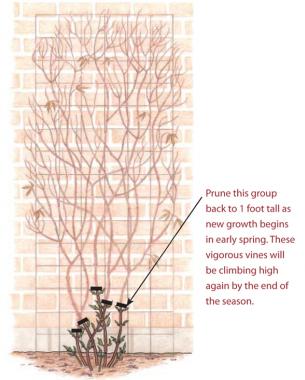
Group 3 vines flower in late summer or in fall, on new growth produced earlier in the season.
These are the easiest vines to prune. Just before the flavor's growth begins, or as information technology is beginning, lop all stems back to strong buds within a foot or so of the ground. For me, this pruning method is especially of import to keep my sweet fall clematis (C. terniflora) from swallowing up my garage with its rampant growth and spilling the majority of its fragrant white blossoms on the roof.
However, in that location is no need to cut a late-blooming clematis back so severely if you are going to let it constitutional up into a tree where y'all want its blossoms held high. Furthermore, certain plants in this category, such every bit C. orientalis cultivars and C. tangutica, start blooming earlier and so continue longer if they are not cut back so hard.
If these instructions however seem confusing, the "practice about cipher" method can piece of work with most clematis equally long as you don't mind an unmanageable vine. A desperate pruning every few years may cede some blooms in the short term, but it will bring the plant to a more manageable size and, in getting rid of decrepit old stems, stimulate young replacement stems that volition put more flowers at eye level.
Acquire more than near clematis
The Many Faces of Clematis
Go to know the wide variety of flower shapes and sizes this popular vine offers.
Clematis with Everything
An gorging collector uses shrubs and perennials every bit living trellises for these flowering vines.
Three Myths about Clematis
Think you know clematis? Call back again.
Get our latest tips, how-to manufactures, and instructional videos sent to your inbox.
The Latest
Collection
Digging Deeper Into Sustainable Garden Design

Design
Gardening Gift Ideas for Mother'south Day 2022

-

How-To
Giving Dorsum Through Gardening: Part two

Source: https://www.finegardening.com/article/pruning-clematis
0 Response to "If You Cut Back Clematis in Summer Will It Bloom Again"
Post a Comment